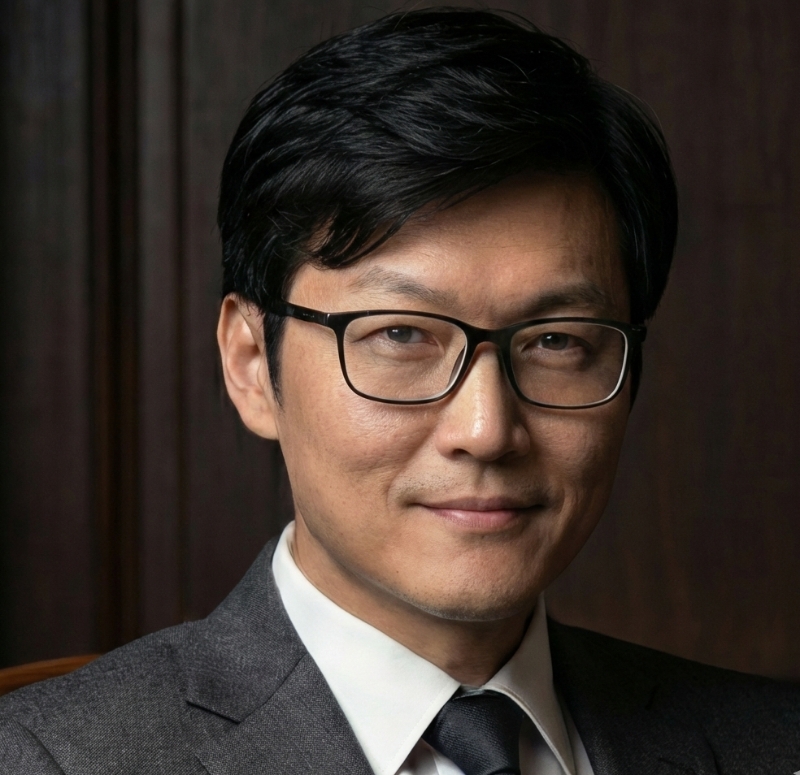
Recently, a research team led by Professor Zhonggang Wang from the School of Traffic and Transportation Engineering at Central South University proposed an integrated design method for high-performance sound-absorbing metamaterials, incorporating non-Hermitian acoustics, rainbow trapping, and hierarchical scale effects. The research, titled “Asymmetric hierarchical acoustic absorber at exceptional point: A loss-induced eigenvalues degeneracy system,” was published in the internationally renowned physics and acoustics journal, the NI journal “Physical Review B.” Doctoral student Zichao Guo from the school is the first author of the paper, and Professor Zhonggang Wang is the corresponding author.
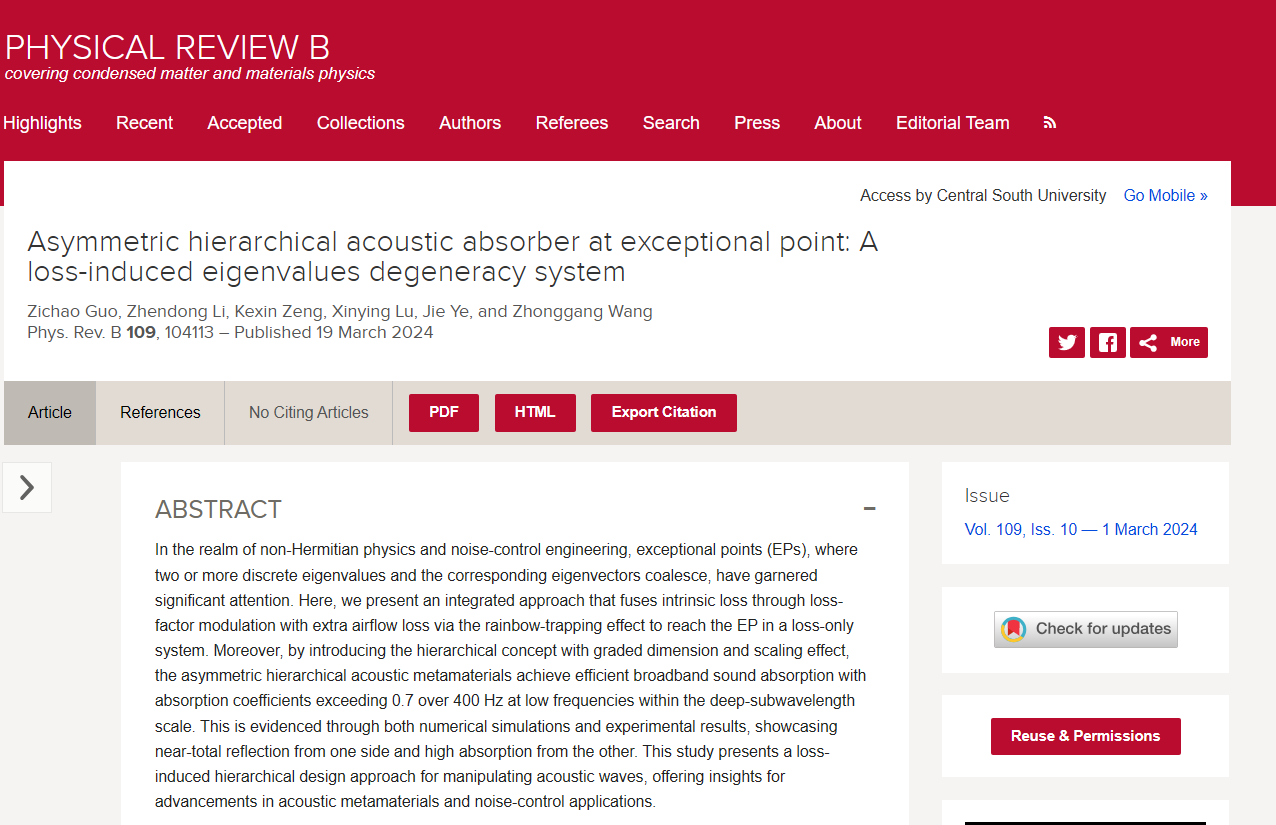
Due to the long wavelength and difficulty in attenuation of low-frequency sound waves, how to efficiently suppress low-frequency noise in engineering has been a major research hotspot and challenge. To address this, building on previous research on hierarchical structures, the team proposed a method for modulating the loss factor in sound absorption systems. They designed a class of dual-channel hierarchical high-efficiency sound absorption structures and established an integrated method combining non-Hermitian acoustics, rainbow trapping, and hierarchical scale effects. By modulating the evolution process of the loss factor, unidirectional quasi-total absorption asymmetric acoustic properties can be achieved. The physical mechanisms were revealed through theoretical analysis and simulation. The proposed integrated method can be extended to other acoustic models, providing new insights for studying broadband acoustic energy dissipation systems.
It is reported that “Physical Review B” is one of the internationally recognized journals in the field of acoustics, enjoying high academic reputation. In recent years, with support from national and provincial-level projects, the research team led by Professor Zhonggang Wang has explored efficient sound absorption using acoustic metamaterials, with related findings published in internationally authoritative journals such as MH, APL, VPP, EML, and ACS AMI.
Professor Zhonggang Wang is primarily engaged in teaching and research on structural strength and dynamics of railway locomotives and rolling stock. Since March 2024, he has served as an editorial board member for the international journal “Virtual and Physical Prototyping” (JCR Q1, Impact Factor 10.6).
First Review: Shangjun Wang Second Review: Yuan Li / Zhonggang Wang Third Review: Helai Huang