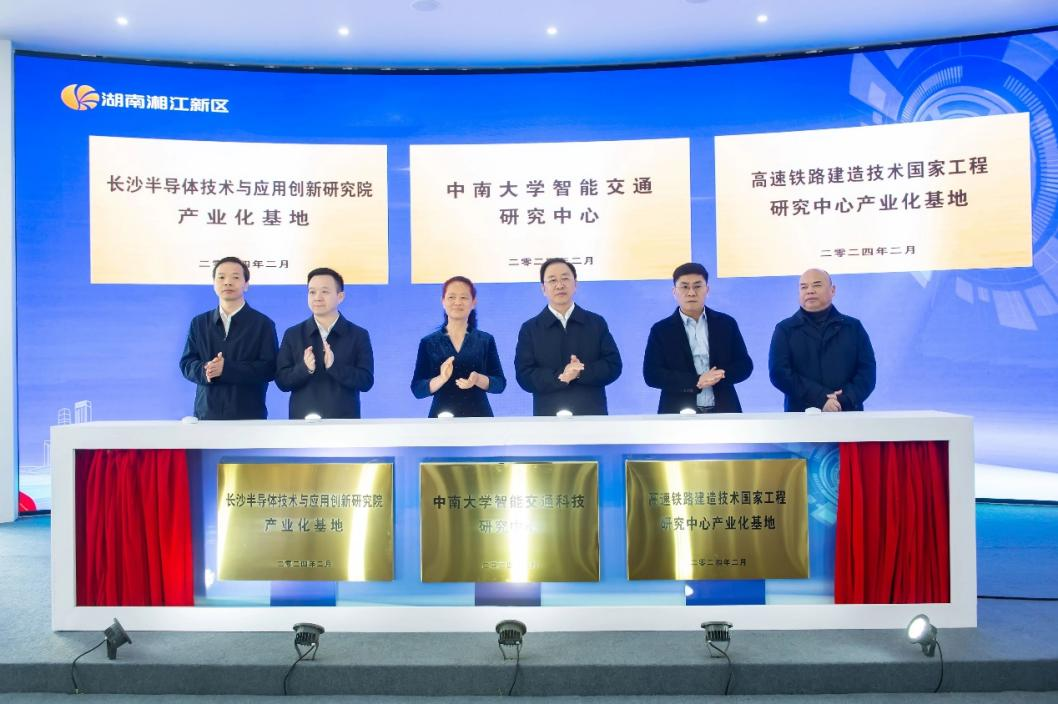
On the afternoon of February 19, the “Central South University Intelligent Transportation Research Center,” jointly established through an agreement signed between the School of Traffic and Transportation Engineering of Central South University (representing the university) and the Yuelu High-Tech Zone of Hunan Xiangjiang New Area, was officially inaugurated. It is located at the Intelligent Sensing and Connected Industry Base within Xiangjiang Science City.
Huang Helai, Dean of the School of Traffic and Transportation Engineering, stated that the discipline of Traffic and Transportation Engineering at Central South University, built upon decades of historical foundation, has developed into a national Double First-Class construction discipline and a national key first-level discipline. It is a pivotal hub for cultivating advanced talents and conducting cutting-edge scientific research in fields such as rail transit equipment and intelligent traffic control in China. The collaboration between Central South University and Xiangjiang New Area to jointly build an industry-research integrated intelligent transportation R&D base is a mutually beneficial and win-win endeavor. It is hoped that through this cooperation, the goal of creating a connector for integrating discipline, industry, and research, as well as an incubator for transforming achievements, can be achieved. This aims to support the realization of the discipline’s goal of reaching international first-class standards, serve national and local economic development, and contribute the strength of Central South University’s transportation expertise to Changsha’s efforts to build a global R&D center.
It is reported that the Intelligent Sensing and Connected Incubation Base within Xiangjiang Science City is a comprehensive incubation platform established to implement the “Global R&D, Starting from Xiangjiang” initiative, drive innovation leadership, and rapidly cultivate the intelligent sensing and connected industry. The “Central South University Intelligent Transportation Research Center,” established through this agreement, comprises four research directions: “Rail Vehicles and Intelligent Equipment,” “Rail Transit Control and Detection,” “Intelligent Connected Transportation and Vehicles,” and “Smart Logistics Systems and Equipment.” It is dedicated to addressing major national and industry demands and incubating large-scale platforms and high-quality innovative teams that meet industry development needs. In the future, both parties will collaborate to promote the transformation and application of more research outcomes, fostering new cross-integrated industries and growth points, thereby supporting the transformation of scientific and technological industries at the provincial and municipal levels.
First Review: Shangjun Wang Second Review: Yuan Li Third Review: Helai Huang