The 17th International Symposium on Computational Transportation Science (CTS 2026) was held in Changsha, Hunan Province, from August 7 to 9. The symposium was co-hosted by Central South University and the Organizing Committee of the International Symposium on Computational Transportation Science (CTS). It was jointly organized by the School of Traffic and Transportation Engineering of Central South University, the State Key Laboratory of Heavy-duty and Express High-power Electric Locomotive, and the Key Laboratory of Complex Systems Analysis and Management Decision of the Ministry of Education; co-organized by CRSC Low-Altitude Intelligent Technology Co., Ltd.; and supported by "Future Urban Traffic Management," a project under the National Natural Science Foundation of China (NSFC) Excellence Research Group Program. Under the theme "Digital Intelligence Empowerment and Resilient Collaboration," the symposium brought together more than 500 experts and scholars from 137 universities and research institutions at home and abroad to discuss the frontiers of transportation science.
Attending the opening ceremony were Shi An, Secretary of the CPC Committee of Central South University; Hongqi Tian, Academician of the Chinese Academy of Engineering; Zuoyi Liu, Deputy Director of the Department of Management Sciences of the NSFC; Haijun Huang, CTS Chair and Professor at Beihang University; Hai Yang, CTS Chair and Professor at The Hong Kong University of Science and Technology; Qiang Meng, Academician of the National University of Singapore; and experts and scholars from universities and industry at home and abroad. The opening ceremony was chaired by Shiping Yuan, Secretary of the CPC Committee of the School of Traffic and Transportation Engineering of Central South University.
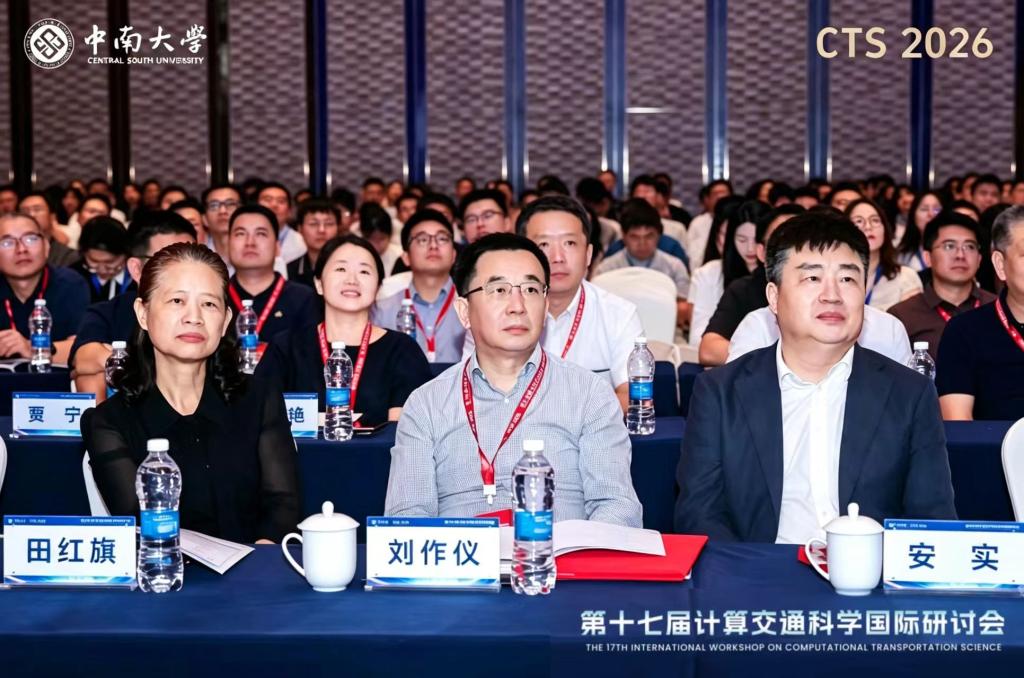
At the opening ceremony, Shi An delivered a welcome address on behalf of the university. He said that Central South University will take the symposium as an opportunity to promote, with the support of Xiangjiang Laboratory, the deep integration of the innovation, industrial, capital, and talent chains, and to build an open platform for cooperation, so as to fulfill its mission of the times in advancing Chinese modernization through the integrated development of education, science and technology, and talent.
Haijun Huang reviewed the symposium's development over more than a decade. Noting that the event has grown from a few dozen participants to its current scale of more than 500, he said it has become the most dynamic platform for academic exchange in transportation in China. He encouraged young scholars to strengthen international academic exchanges and take an active part in international dialogue, so as to enhance the global influence of Chinese scholars, and expressed his hope to see more young faces speak with confidence on the international stage.
Zuoyi Liu pointed out the need to implement General Secretary Xi Jinping's important instructions on strengthening basic research. He expressed the hope that scholars will orient their work toward major national strategic needs, closely combine frontier research with practice, and produce more high-quality original results.
Hai Yang thanked the organizers and praised CTS for maintaining a purely academic and focused atmosphere. He called for carrying forward CTS's fine tradition of "listening attentively and asking thoughtfully," stressing that this quality should be upheld in the era of AI and that scholars should stay true to their original aspiration for academia. He looked forward to working shoulder to shoulder with fellow attendees to advance innovation in transportation science.
Helai Huang, Dean of the School of Traffic and Transportation Engineering of Central South University, reported on the school's progress in building "Double First-Class" disciplines. He noted that the school has made sustained efforts in such fields as heavy-haul locomotives and low-altitude transportation, with notable research achievements. He said the symposium is a concentrated reflection of the school's disciplinary strengths, and that the school will further deepen organized research and international cooperation, contributing to China's efforts to build a country with strong transportation.
The symposium specially invited a group of senior experts in the transportation field to deliver keynote speeches, including Qiang Meng, Academician of the National University of Singapore; Hong Huo, Director of the First Division, Department of Management Sciences, NSFC; Xiaowen Fu, Professor at The Hong Kong Polytechnic University; Xiaoning Zhang, Professor at Tongji University; Zhiyuan Liu, Professor at Southeast University; Xiqun Chen, Professor at Zhejiang University; Jin Qin, Professor at Central South University; and Maochun Zhai, Deputy Director of the General Technology Department of CRSC Low-Altitude Intelligent Technology Co., Ltd. Their presentations covered such frontier topics as high-speed rail operations, maritime transportation, autonomous driving, traffic flow forecasting, transportation large models, green mobility, and the low-altitude economy, fully demonstrating the theoretical innovation and practical exploration in the field of transportation management science.
Thirty-nine thematic sessions were held, featuring in-depth discussions on frontier topics such as transportation network design and optimization, travel behavior, multimodal transport, machine learning and big data, and the low-altitude economy. The sessions saw lively exchanges that effectively promoted the collision of academic ideas and interdisciplinary collaboration. The CTS 2026 Algorithm Competition, held concurrently, attracted 381 teams from at home and abroad; the top ten teams presented their work, showcasing the innovative thinking and technical strength of young talent.
The closing ceremony was chaired by Jianjun Wu, Professor at Dalian University of Technology. In a solemn and lively atmosphere, the symposium presented the CTS Outstanding Doctoral Dissertation Award, the CTS 2026 Outstanding Paper Award, and the CTS 2026 Algorithm Competition Award to recognize young scholars and teams that have achieved outstanding results in the field of computational transportation science. After the awards ceremony, Huang Haijun announced on behalf of the organizing committee that the 18th International Symposium on Computational Transportation Science will be hosted by Guangxi University, and extended a sincere invitation to colleagues from all sectors to meet in Nanning, known as the "Green City," in 2027.
In his closing remarks, Haijun Huang spoke highly of the rich outcomes of the symposium, noting that it reached an excellent level in academic depth, breadth of participation, and organizational support. He expressed sincere gratitude to the School of Traffic and Transportation Engineering of Central South University, and expressed his hope that CTS will continue to lead innovation in global transportation science and contribute to China's efforts to build a country with strong transportation.
First Review: Guangming Xu/Xuekai Cen Second Review:Jingyun TanThird Review: Yong Peng