On October 16, the Shanghai Cooperation Organization (SCO) Countries Railway Interconnectivity Capacity Building Training and Study Program commenced at the Railway Campus of Central South University (CSU). Gao Hong, Deputy Director-General of the General Department (International Cooperation Department) of the National Railway Administration, and Li Zhihong, Vice President of Central South University, attended the opening ceremony.
This training program, guided by the development concept of building a community with a shared future for mankind proposed by President Xi Jinping, actively serves the Belt and Road Initiative. It aims to promote exchanges and cooperation in the railway transportation sector among SCO member states, enhance regional railway interconnectivity capacity, and support the ‘going global’ strategy of China’s railways. Commissioned by the National Railway Administration, Central South University is undertaking this project for the first time. The participants consist of 20 experts and officials from the transportation, equipment, logistics, and management departments of the Belarusian Railway and the Kyrgyzstan State Railway Company.
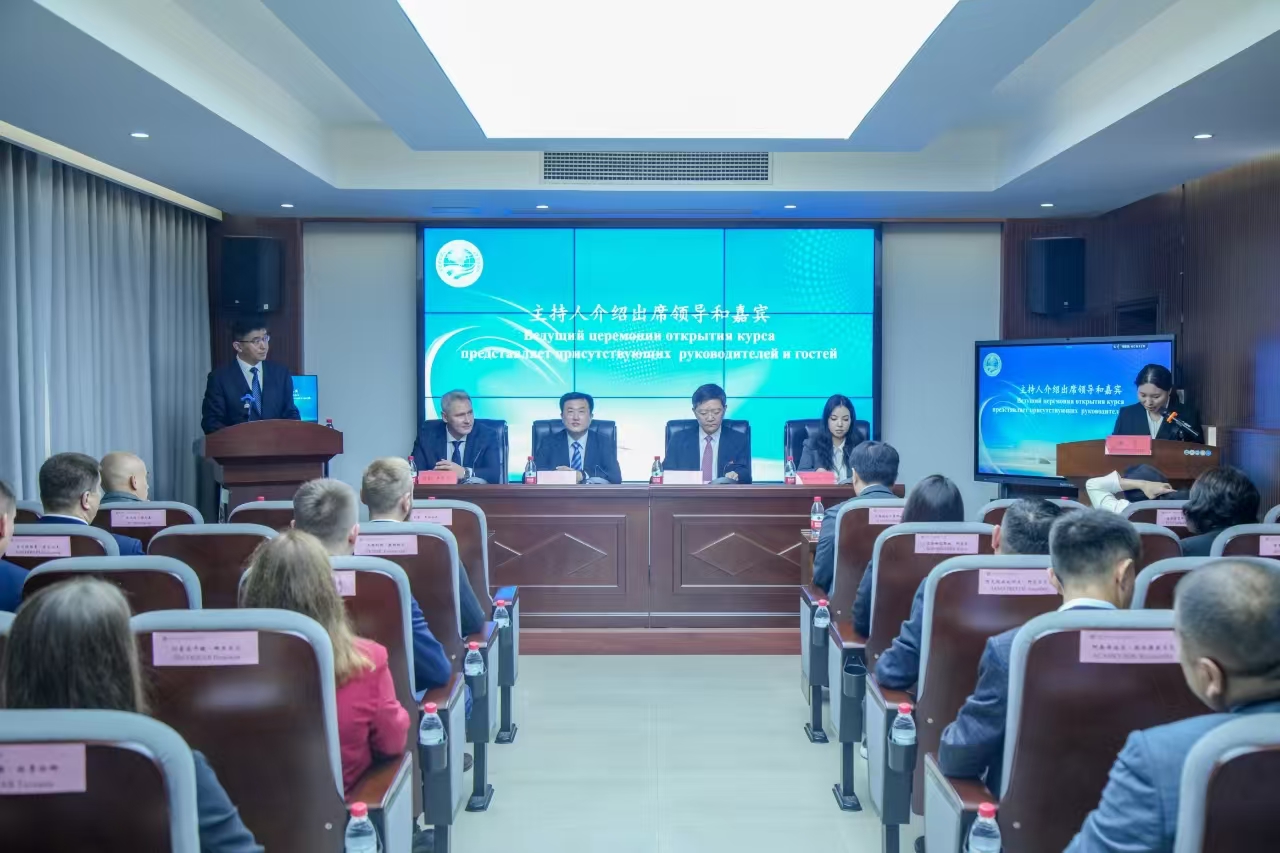
Gao Hong stated that this training and study program is one of the important measures taken by China to actively promote railway exchanges and cooperation with SCO member states. Over the 23 years since the establishment of the SCO, member states, upholding the ‘Shanghai Spirit,’ have achieved significant results in areas such as aligning railway development policies and plans and enhancing regional railway interconnectivity. China is willing to strengthen exchanges and mutual learning with railway counterparts from SCO member states including Belarus and Kyrgyzstan, actively share respective railway development experiences, and jointly promote new developments in the railway sector of the SCO.
Li Zhihong extended a warm welcome to the participants from the two countries for their study and exchange at the university. He briefly introduced the development of Central South University and its achievements in teaching, research, and international cooperation in the field of rail transportation. On behalf of the university, he pledged to provide participants with the highest quality teaching services and the most advanced technologies in railway transportation, logistics management, and intelligent equipment, thereby making new contributions to the friendship between China and Belarus and Kyrgyzstan.
Bely Alexander Sergeyevich, Deputy Head of the Foreign Relations Department of the Belarusian Railway, and Aigemberdieva Malika Aripzhanovna, Head of the International Cooperation Department of the Kyrgyzstan State Railway Company, delivered speeches. They expressed gratitude to the National Railway Administration of China and Central South University for providing this learning and exchange opportunity and expressed their anticipation for strengthening exchanges and cooperation with China in the railway field.
This training program lasts for 10 days. Drawing on its previous international education and training experience, Central South University has coordinated high-quality educational resources from both within and outside the university, designing a training plan based on a modular and systematic approach. The training program consists of six modules: Railway Construction Technology, Railway Equipment Technology, Railway Operation Organization, Railway Logistics Development, Cultural Exchange, and On-site Teaching. It adopts a training model of ‘special lectures + on-site teaching + study tours + consulting services.’ Professors and experts from Central South University, the National Railway Administration, China Railway Signal & Communication Corporation (CRSC), CRRC Corporation Limited, China Railway Construction Corporation Limited (CRCC), and railway vocational colleges are invited to conduct the training. Considering the socio-economic development, current status of railway construction and operation, and the characteristics of the participants from Kyrgyzstan and Belarus, the program includes activities such as experiencing ‘China Speed’ and showcasing ‘Made in China.’ It also features visits to the National Engineering Research Center for High-speed Railway Construction Technology at CSU, the Key Laboratory of Traffic Safety on Track of the Ministry of Education, as well as rail transportation industry units like CRRC Zhuzhou Locomotive Co., Ltd. and China Railway Construction Heavy Industry Group Co., Ltd.
(Article reprinted from CSU News Network. First review: Wang Xuan. Second review: Han Yan. Third review: Wang Jianxiang.)